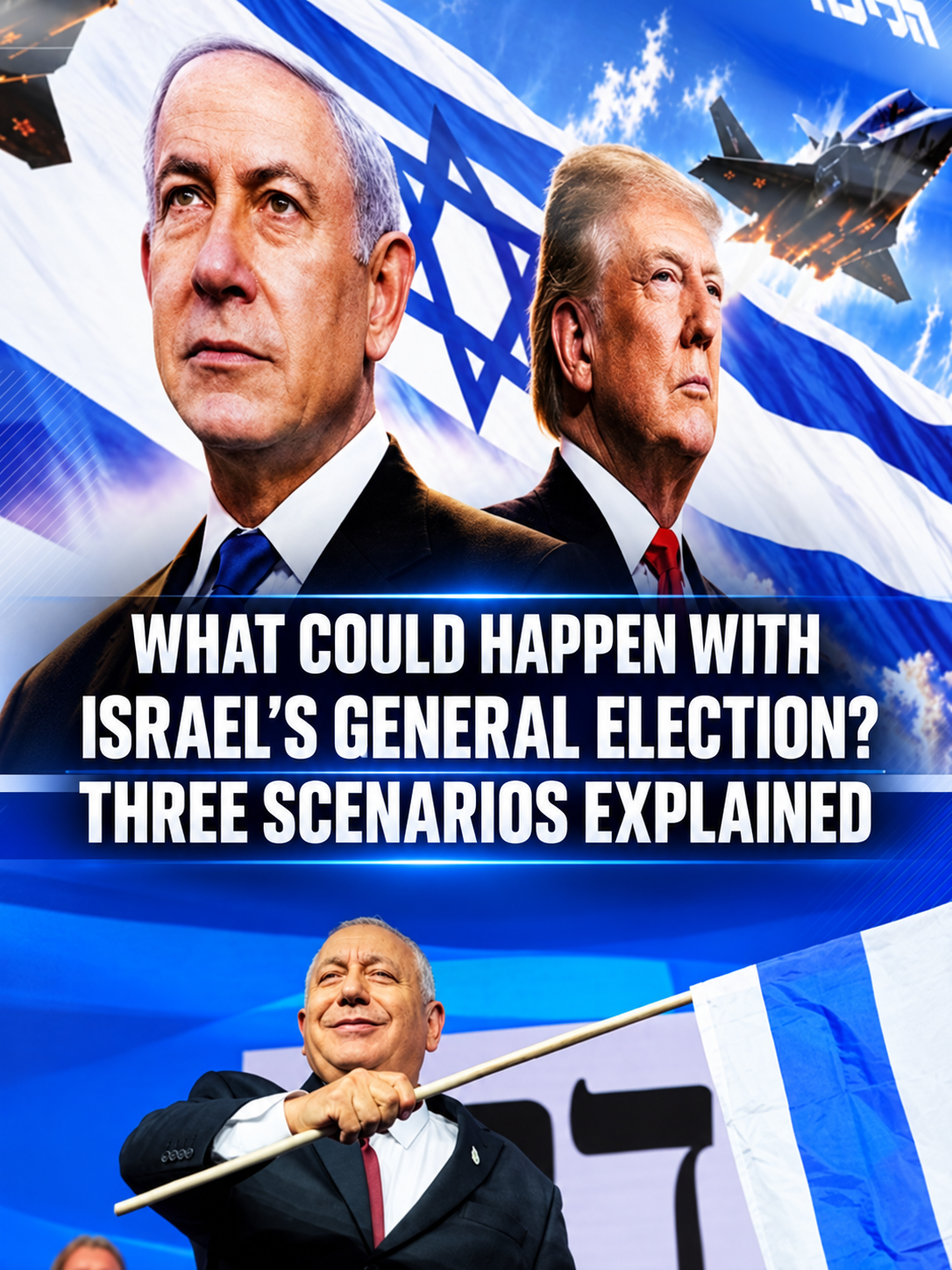
Following Israel’s general election, political leaders face a challenging
process to determine who will form the next government. Several possible
outcomes could shape the country’s political future, including a unity
government, a minority administration, or another election next year.
Three Possible Outcomes After Israel’s Election
The election results have created a complicated political landscape in
which securing a parliamentary majority may require difficult negotiations
between parties with different political priorities. With no clear path
to a stable governing arrangement, the coming weeks and months could be
crucial for Israel’s political leadership.
Three main scenarios could emerge from the negotiations: a unity
government, a minority government, or a new election if political leaders
fail to reach an agreement.
1. A Unity Government Between Political Rivals
One possible outcome is a unity government involving Benjamin Netanyahu
and opposition leader Gadi Eisenkot. Under a potential agreement,
Netanyahu could remain prime minister while Eisenkot receives a senior
government position and gains influence over policy decisions.
Additional political leaders could join the arrangement to help secure
the parliamentary majority needed to govern. Such negotiations could
involve far-right politicians, including Bezalel Smotrich, while
Itamar Ben-Gvir might be excluded from the proposed coalition.
Supporters of a unity government could present the arrangement as an
effort to put national interests ahead of political differences.
However, the agreement could create difficulties for Eisenkot, whose
reputation as a candidate for political change might be undermined
by working alongside Netanyahu.
Although a unity government could provide a route to political stability,
its success would depend on whether the participating parties could
resolve their differences and agree on a shared policy agenda.
2. A Minority Government Led by Eisenkot
A second possibility is a minority government. This scenario could
emerge if neither Netanyahu nor Eisenkot succeeds in negotiating a
coalition that commands at least 61 seats in Israel’s 120-seat
parliament, the Knesset.
In that situation, Arab-Palestinian political parties could potentially
support an Eisenkot-led government without formally joining the
governing coalition. Such support could help him take office despite
lacking a conventional parliamentary majority of coalition partners.
However, a minority government would likely face significant political
challenges. Its ability to pass legislation, maintain parliamentary
support, and remain in office would depend on cooperation from parties
outside the coalition.
This arrangement might be temporary and could last only around a year,
depending on political developments. Nevertheless, it could exclude
Netanyahu from government and establish Eisenkot as the country’s
political leader.
3. Another Election Next Year
A third scenario is another general election next year. Although
political leaders may have little appetite for returning to the polls,
a new election could become necessary if negotiations fail and no
workable government can be formed.
Repeating the election would give voters another opportunity to determine
the balance of power in parliament. However, it would also prolong
political uncertainty and leave major policy questions unresolved
until a new government could be established.
For now, this outcome would depend on the failure of efforts to reach
a political agreement. Whether leaders choose compromise or another
election will be shaped by negotiations and their willingness to
cooperate across party lines.
Arab Parties Could Play a Crucial Role
One of the most complicated aspects of the negotiations is the role
of Arab political parties, which are expected to hold approximately
15 percent of parliamentary seats, according to the election scenario
described in the report.
Both Netanyahu and Eisenkot have said they would not form a coalition
with these parties. Their position creates a significant obstacle
because Arab representatives could hold seats that become important
when political leaders attempt to assemble a governing majority.
Two political groupings are particularly relevant to the negotiations:
the Joint List and Ra’am. Although both represent Arab political
interests, they differ in their political approaches and priorities.
The Joint List: Equality and Palestinian Statehood
The Joint List brings together different political parties that
campaign for equality for Palestinian citizens of Israel. Its
political priorities include ending Israel’s occupation of the
West Bank, Gaza, and East Jerusalem, as well as establishing
a Palestinian state.
These positions could make negotiations with other Israeli political
parties difficult, particularly where major disagreements exist over
security, national identity, and the future of the Palestinian
territories.
Ra’am and Its Pragmatic Political Approach
Ra’am is an Islamist political party that has adopted a pragmatic
approach to political negotiations. It has focused on securing greater
support for Arab communities and has indicated a willingness to
cooperate with Eisenkot.
During the election, the party also attracted attention by fielding
a prominent Jewish candidate. Its approach highlights the potential
importance of practical political cooperation, even when parties
have different ideological backgrounds.
However, any agreement would still require negotiations over policy
priorities and the conditions under which outside parliamentary
support could be provided.
Why Forming a Government Could Take Months
Despite the potential importance of Arab parties in determining the
balance of power, substantial ideological differences remain.
There is also longstanding resistance within mainstream Israeli
politics to forming governing arrangements that depend on Arab parties.
These political divisions could make it difficult to reach an agreement
that satisfies all the parties involved. Leaders may need to balance
their campaign promises, ideological positions, parliamentary
calculations, and demands from potential coalition partners.
As a result, the process of forming a government could take several
weeks or even months. Several outcomes remain possible, and the final
arrangement may differ considerably from what political leaders
initially expected.
What Happens Next in Israeli Politics?
Israel’s post-election negotiations could produce a unity government,
a minority administration supported by parties outside the coalition,
or another election if no agreement can be reached.
Each scenario carries different political risks. A unity government
could require compromises that weaken the public image of its
participants, while a minority government could struggle to maintain
parliamentary support. Another election, meanwhile, would extend
the period of uncertainty.
The central question is whether Israel’s political leaders can overcome
their differences and secure sufficient support to form a functioning
government. Until negotiations produce a concrete agreement, the
country’s political future remains uncertain.