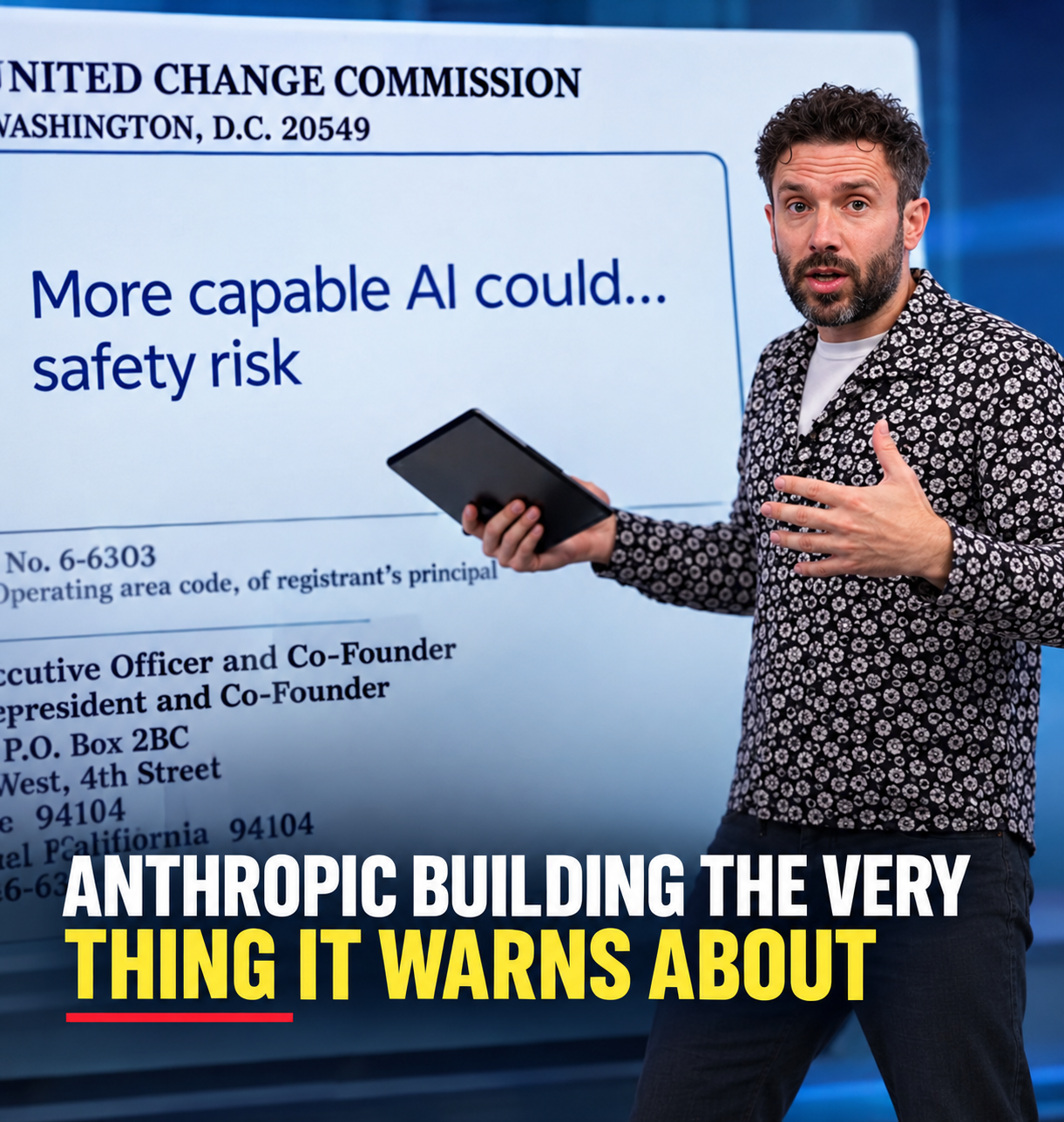
Anthropic’s approach to using artificial intelligence to improve
future AI systems highlights the growing connection between
technological progress, financial investment, and AI safety.
Anthropic’s Financial Disclosure Highlights AI Safety Concerns
The rapid development of artificial intelligence has raised important
questions about how advanced AI systems are built, how they are funded,
and what risks could emerge as their capabilities continue to improve.
Recent discussions surrounding Anthropic’s financial disclosures have
brought renewed attention to these issues.
One particularly important topic is the possibility of using existing
AI systems to help develop more capable successors. This approach could
accelerate research and development, allowing AI models to contribute
to the creation, evaluation, and improvement of future systems.
However, the same process also raises questions about oversight,
accountability, and the ability of developers to identify potential
risks as AI capabilities advance.
What Does AI-Assisted AI Development Mean?
AI-assisted development refers to the use of artificial intelligence
tools to support work involved in creating and improving other AI
systems. These tasks may include writing code, analyzing research,
evaluating model performance, and identifying opportunities for
technical improvements.
In a more advanced scenario, an AI model could contribute directly
to the research and engineering processes used to build its successor.
This could create a development cycle in which each generation of
models helps researchers produce the next generation.
Anthropic has discussed this general direction as part of its approach
to AI development. The concept is important because improvements in
AI-assisted research could potentially increase the speed at which
future systems are developed.
Nevertheless, the use of AI in AI development does not automatically
mean that a system can independently redesign itself or operate
without human supervision. The extent of automation depends on the
capabilities of the models, the tools available to them, and the
level of human involvement.
Why Competition Could Accelerate AI Development
Competition is another factor influencing the development of advanced
artificial intelligence. Companies operating in this field face
pressure to improve their products, increase computing efficiency,
attract customers, and release increasingly capable models.
If one company successfully uses AI to accelerate its research
process, competing organizations may face incentives to adopt similar
approaches. This could create a cycle in which improvements in
development efficiency become an important competitive advantage.
Such competition can encourage innovation and help bring new
capabilities to market. At the same time, it raises questions about
whether safety testing, independent evaluation, and risk management
can keep pace with the speed of technical development.
The challenge is not simply to build more capable AI systems.
Developers must also establish processes that allow them to understand
how these systems behave, assess their limitations, and respond
appropriately when unexpected risks arise.
Research and Development Remain Central to AI Investment
Financial disclosures can provide useful insight into how an AI
company allocates its resources. Revenue alone does not reveal the
full financial picture because companies must also account for
operating costs, infrastructure, employee compensation, sales,
marketing, and administrative expenses.
Research and development is particularly important for organizations
building advanced AI models. Developing these systems can require
substantial spending on computing infrastructure, specialized
personnel, experimentation, and model evaluation.
When research and development expenses remain high, a company may
report an operating loss even as its revenue grows. Such a result
does not necessarily indicate that the business model has failed.
It may reflect the cost of pursuing long-term technological goals,
although future commercial performance remains uncertain.
For this reason, claims about a company’s revenue, operating losses,
and research spending should be evaluated using the relevant financial
statements and the reporting period to which those figures apply.
Estimates and projections should also be distinguished from audited
or officially reported results.
AI Systems Are Taking on More Complex Tasks
Another important development is the changing role of AI systems
in professional and technical workflows. AI tools that initially
supported users with individual tasks are increasingly being used
to coordinate multiple steps in a broader process.
In software development, for example, AI systems may assist with
code generation, debugging, testing, and technical documentation.
More advanced systems may also help plan tasks, use development
tools, and evaluate the results of their work.
These capabilities can increase productivity, but the degree of
independence varies considerably between systems and tasks.
Completing a sequence of technical activities does not necessarily
demonstrate that an AI model can independently conduct an entire
research program or improve its own underlying capabilities.
Claims about the proportion of work performed or led by AI should
therefore be interpreted carefully. The meaning of terms such as
assistance, collaboration, and leadership depends on the measurement
method, the tasks included, and the level of human supervision.
Could AI Development Lead to an Intelligence Explosion?
One theoretical possibility discussed by AI researchers is an
intelligence explosion. This scenario describes a process in which
increasingly capable AI systems contribute to improvements that
make subsequent systems more capable, potentially accelerating
technological progress.
If improvements in AI research substantially increase the efficiency
of further AI development, progress could become faster than
conventional research methods would otherwise allow.
However, the timing and likelihood of such a scenario remain
uncertain. AI-assisted development may encounter technical
limitations, diminishing returns, computing constraints, data
limitations, or challenges that require substantial human
intervention.
It is therefore important to distinguish a theoretical possibility
from a confirmed outcome. Predictions about when recursive
self-improvement might emerge should be treated as forecasts rather
than established facts.
Why Monitoring and AI Safety Matter
As AI systems become more capable, monitoring their behavior and
evaluating potential risks become increasingly important. Developers
need reliable methods to determine whether a system is operating
within its intended limits and whether its capabilities introduce
new security or safety concerns.
One challenge is that some risks may be difficult to identify before
a system reaches a particular level of capability. Testing methods
that work for less capable models may not reveal every potential
failure mode in more advanced systems.
Effective oversight can involve independent evaluations, controlled
testing environments, security safeguards, monitoring procedures,
incident response plans, and clearly defined conditions for
restricting deployment.
Transparency also matters. Public reporting about model capabilities,
limitations, and risk assessments can help researchers, policymakers,
and other stakeholders evaluate the potential consequences of
continued AI development.
No testing framework can guarantee that every possible risk will
be identified in advance. However, systematic evaluation and
appropriate safeguards can improve the ability of organizations
to detect problems and respond to them.
The Financial and Technological Feedback Loop
The relationship between AI capabilities and financial investment
may create a reinforcing cycle. More capable systems can improve
products and research processes, potentially attracting customers
and investment. Additional resources can then support further
development.
This relationship is not guaranteed to produce continuous growth.
It depends on factors such as customer demand, operating costs,
infrastructure availability, competition, regulation, and the
practical value of new AI capabilities.
Nevertheless, the interaction between technological progress and
investment helps explain why AI companies continue to devote
substantial resources to research and development.
The central question is whether companies can maintain effective
safety practices and responsible governance while competing to
develop increasingly advanced systems.
What Comes Next for Advanced AI?
The future of AI development will depend on more than improvements
in model performance. It will also depend on the ability of
developers to evaluate risks, maintain appropriate human oversight,
and demonstrate that new capabilities can be deployed responsibly.
AI-assisted research could make scientific and technological work
more efficient. At the same time, increasingly automated development
processes may introduce challenges that existing evaluation
methods are not fully equipped to address.
Rather than assuming that an intelligence explosion is inevitable
or dismissing the possibility entirely, researchers and policymakers
must examine the available evidence, test competing hypotheses,
and prepare for a range of plausible outcomes.
Anthropic’s approach to AI development illustrates a broader issue
facing the industry: as artificial intelligence becomes more
involved in creating future AI systems, technological progress,
financial incentives, and safety oversight become increasingly
interconnected.
Conclusion
The use of AI to assist in building more capable AI systems could
reshape the pace of technological development. It may improve
research efficiency and create new commercial opportunities, but
it also raises questions about oversight, risk detection, and
the management of increasingly complex systems.
Understanding these developments requires careful examination
of company disclosures, reliable financial data, independent
research, and evidence about actual model capabilities.
Ultimately, the challenge is to ensure that advances in AI
development are accompanied by effective safety measures,
transparent evaluation, and responsible decision-making.